Introduction
Contemporary applications are expected to support real-time operations, handle large volumes of data, and remain reliable across varying network conditions. As systems become more distributed and performance-sensitive, application architecture has become just as critical as functionality itself. However, traditional design models often struggle to meet these modern demands, particularly in terms of latency, scalability, and resilience.
These challenges have driven the evolution of new architectural approaches that extend beyond centralized cloud computing and incorporate edge computing as a core component. By distributing computation closer to where data is generated, modern application architectures enable faster responses, improved reliability, and more efficient use of resources. This article explores next-generation application architecture, introduces the fundamentals of edge computing, and examines both the benefits and trade-offs of moving computation closer to the edge.
Why Traditional Architectures Fall Short
Traditional architectures particularly centralized, cloud-only or monolithic systems were built for environments where network connectivity was reliable and latency was not a critical concern. As modern application requirements have evolved, these architectures increasingly struggle with issues such as higher latency caused by processing data in distant cloud servers, heavy dependence on continuous internet connectivity that can lead to downtime, scalability bottlenecks as systems grow, and rising data transfer costs due to constant communication with centralized infrastructure. For applications that demand real-time decision-making or must operate in remote or bandwidth-constrained environments, these limitations can significantly degrade performance, reliability, and overall user experience.
As a result, Modern Application Architectures have emerged to address these shortcomings by prioritizing responsiveness, resilience, and distributed processing.
What is Modern App Architecture
Modern application architecture refers to the way contemporary software systems are designed to be scalable, resilient, modular, and adaptable. Unlike traditional monolithic applications, modern architectures break systems into smaller, independent components that can evolve and scale independently.
Characteristics of Modern App Architecture
- Decoupled components : Services are loosely connected, reducing dependencies.
- API-driven communication : Components interact through well-defined APIs.
- Scalability by design : Individual parts can scale without affecting the entire system.
- Resilience and fault tolerance : Failures are isolated rather than system-wide.
- Distributed deployment : Applications run across cloud, edge, and sometimes on-premise environments.
Common architectural patterns used today include microservices, event-driven systems, and hybrid cloud-edge models. These patterns allow developers to design applications that are better suited to real-world conditions such as fluctuating traffic, partial outages, and performance constraints.
Many popular platforms use modern application architecture to deliver scalable and reliable services. For example, Netflix uses microservices and distributed cloud infrastructure to stream content to millions of users worldwide without interruption. Uber relies on distributed services and real-time data processing to match drivers and passengers instantly. Similarly, Amazon operates independent services for orders, payments, and delivery, allowing each component to scale separately and continue functioning even if one service encounters issues. These examples show how modern architectures support large-scale, real-time applications used every day
Edge Computing
Edge computing is a computing paradigm where data processing happens closer to the source of data generation, rather than exclusively in centralized cloud servers. This means computation can occur on devices, local servers, gateways, or nearby nodes at the “edge” of the network. Instead of sending every piece of data to the cloud for processing, edge computing allows applications to:
- Process data locally
- Make immediate decisions
- Synchronize with the cloud only when necessary
Edge computing does not replace the cloud. Instead, it complements cloud computing by distributing workloads more intelligently across the system.
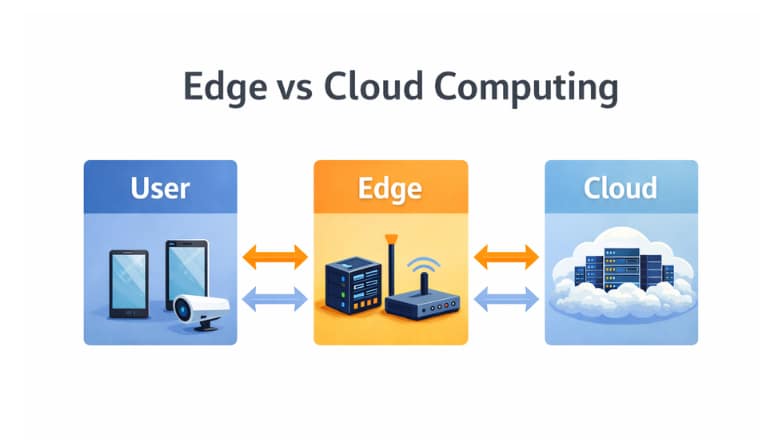
When a user interacts with a device, like a phone, laptop, or camera, the device generates data. This data can be processed in two places: at the edge or in the cloud. Edge computing happens close to the user, using local servers, routers, or small computers, so it can respond quickly like a camera detecting motion and turning on an alarm instantly. Cloud computing happens far away in large data centers. It is used to store data, run heavy analysis, or train AI models, but it takes more time because the data has to travel over the internet.
Key Characteristics of Edge Computing
Edge computing introduce several distinctive characteristics into application design:
- Low latency processing : Decisions are made close to where data is generated.
- Offline or Limited-Connectivity operation : Systems can continue functioning without constant internet access.
- Reduce bandwidth usage : Only relevant or aggregated data is sent to the cloud.
- Localized intelligence : Devices or edge nodes can act independently when needed.
These Characteristics make edge computing particularly valuable for performance-sensitive and mission-critical applications.
Benefits of Edge Computing in Modern Applications
Edge computing brings key advantages to modern applications by processing data closer to where it is generated. This approach improves performance, enhances reliability, reduces costs, and strengthens data privacy, while also supporting scalable systems.
- Improved Performance and Responsiveness : When data is processed at the edge, it does not have to travel long distances to the cloud. This reduces delay and allows applications to respond faster, enabling real-time actions and smoother user experiences.
- Greater Reliability : Applications can continue to operate even when internet or cloud connectivity is slow or temporarily unavailable. This makes systems more reliable in environments with unstable networks.
- Reduced Cloud Costs : By processing and filtering data locally, only important information is sent to the cloud. This reduces data transfer, lowers cloud usage, and helps control operational costs.
- Enhanced Data Privacy and Security : Sensitive data can be processed locally at the edge instead of being sent across networks. This reduces exposure and helps improve data privacy and security.
- Better Scalability : Instead of relying on a single central system, workloads are shared between edge nodes and cloud services. This distribution prevents overload on one location and allows the system to scale smoothly as the number of users or devices increases.
Challenges of using Edge Computing
Edge computing brings significant benefits, such as reduced latency and improved real-time processing. However, deploying and managing edge systems introduces several challenges that developers must address to ensure performance, security, and reliability across distributed environments.
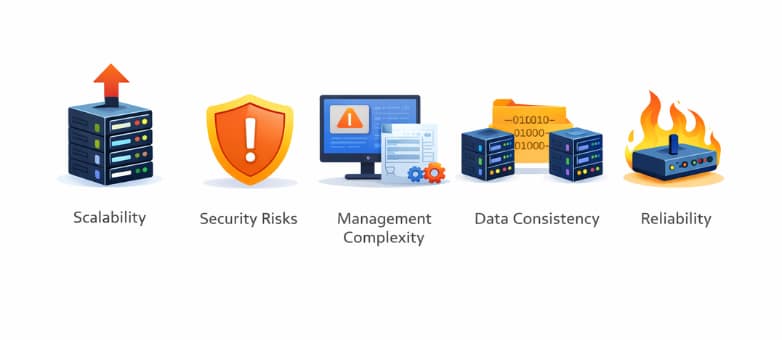
- Increased System Complexity: Edge systems are geographically distributed, requiring centralized coordination, monitoring, and control across both cloud and edge environments.
- Device Management Overhead: Edge devices require regular software updates, maintenance, and security audits, increasing operational effort.
- Security Risks at the Edge: Because edge devices are deployed close to users, they can be more vulnerable to physical access, tampering, and cyberattacks if not properly secured.
- Limited Resources and Scalability: Edge devices typically have limited processing power and storage compared to cloud servers, making it challenging to scale applications efficiently.
- Data Consistency and Reliability: Managing consistent data across distributed edge devices and ensuring reliable operation during network or hardware failures can be difficult.
Cloud and Edge Together: A Hybrid Approach
Modern application architecture is rarely cloud-only or edge-only. Instead, it adopts a hybrid model, where:
- The cloud handles centralized processing, analytics, storage, and scaling.
- The edge manages real-time processing, local decision-making, and offline functionality.
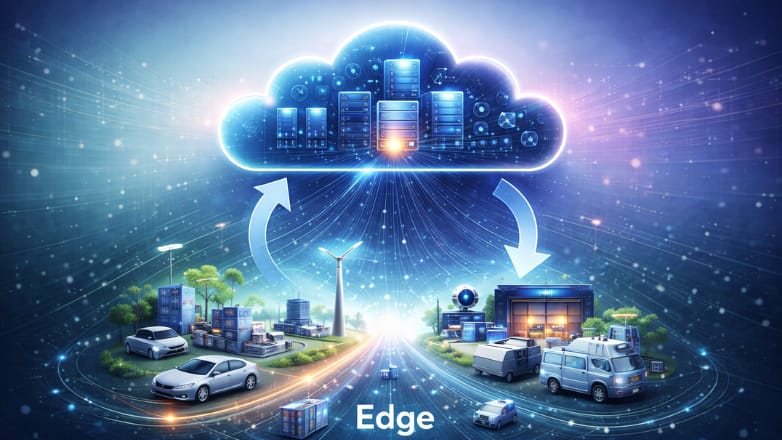
A hybrid cloud–edge architecture combines the strengths of both cloud and edge computing to build modern, flexible systems. Instead of relying entirely on centralized cloud infrastructure or isolated edge devices, this approach distributes responsibilities intelligently across both layers. Time-sensitive tasks and immediate decision-making are handled closer to where data is generated at the edge, while the cloud provides powerful processing, analytics, storage, and scalability.
This collaboration helps reduce latency, improve reliability, and optimize network usage. Even in situations where connectivity is limited or temporarily unavailable, edge components can continue operating independently, ensuring uninterrupted service. Meanwhile, the cloud collects and analyzes data from multiple edge locations, enabling deeper insights, long-term learning, and continuous system improvement.
By working together, cloud and edge environments create applications that are both responsive and intelligent. This hybrid model is especially effective for real-world scenarios such as smart cities, industrial IoT, connected vehicles, and real-time monitoring systems, where performance, resilience, and scalability are equally critical.
This combination allows developers to build systems that are both powerful and practical, capable of adapting to diverse operational environments without sacrificing performance or reliability.
Conclusion
Today’s app development involves more than just selecting the right technologies – it also means designing architectures that can withstand real-world conditions. In the face of moving applications towards more distributed and performance-sensitive workloads, cloud-only approaches frequently fail to deliver on expectations around latency, reliability, scalability and flexibility.
Modern application development is solving this problem by merging cloud computing with edge computing. As cloud remains a dominant force in centralized processing, storage and analytics pushing computing to the edge is bringing computation closer to users and devices which can result in real-time decisions, better resilience and efficient utilization of network and system resources.
At the same time, edge computing introduces new challenges such as increased system complexity, device management overhead, and resource limitations. To successfully adopt this approach, developers need solid architectural planning, strong security practices, and carefully designed systems.
By using a hybrid cloud-edge approach, developers can build applications that are faster, more resilient, and better suited to today’s operational challenges. These architectural patterns provide a strong foundation for building the next generation of applications that can scale effectively and perform reliably in an increasingly connected and distributed world.